China's Sea Freight Rates Surge in December: SCFI Up 2.9% MoM, US West Coast Route Leads with 9.1% Gain
2025-10-29
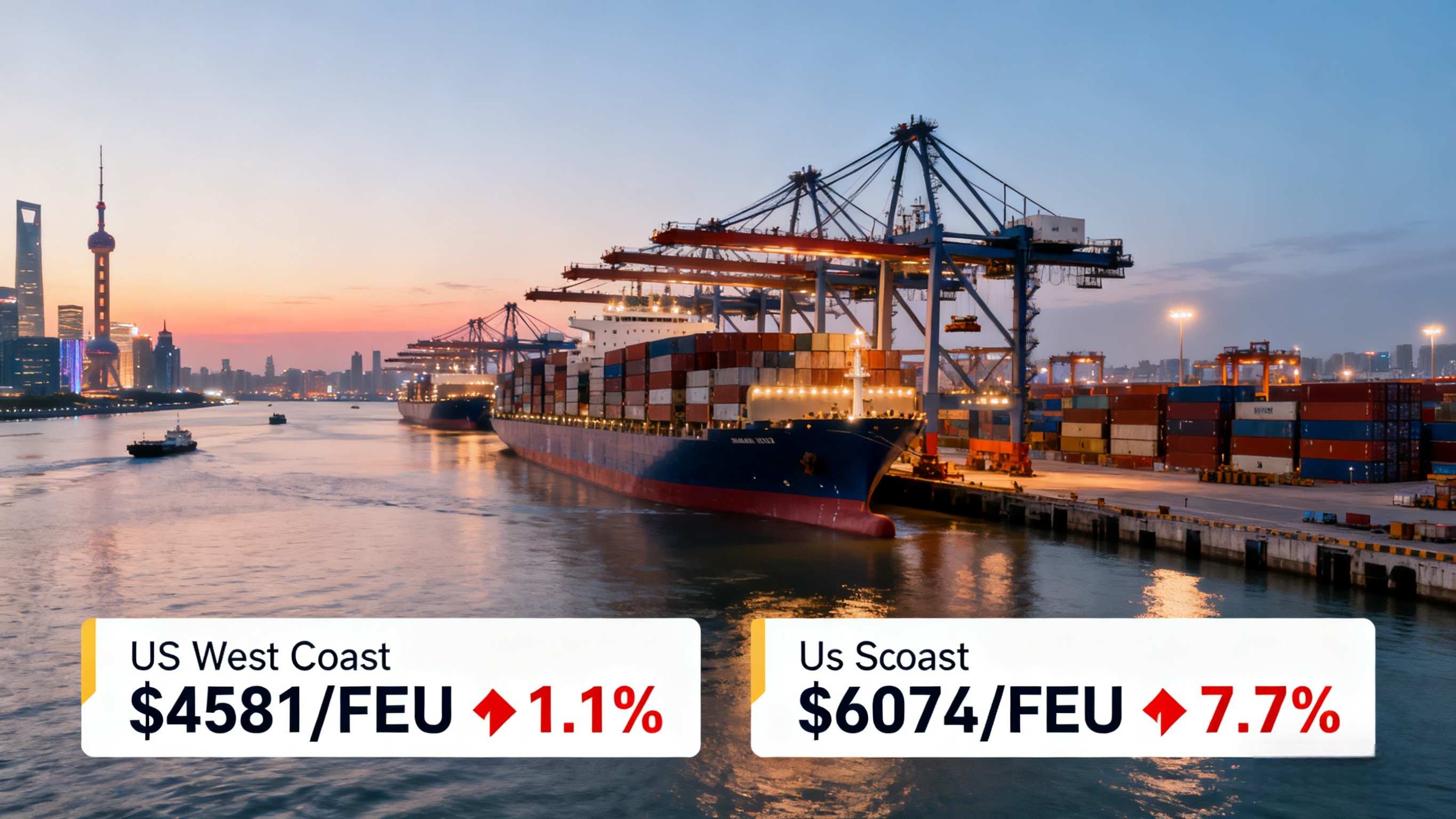
Latest data released by the Shanghai Shipping Exchange (SSE) on December 27 showed that the China Export Containerized Freight Index (SCFI) closed at 2,460.34 points, up 2.9% from the previous week, hitting a periodic high since December. The North American routes emerged as the core driver of this round of price increases, with freight rates for the US West Coast and US East Coast routes breaking through the 4,500/FEUand6,000/FEU marks respectively, both registering month-on-month (MoM) gains of over 7%—a development that has attracted widespread attention from cross-border trade enterprises.
Route Divergence Prominent: North American Routes Drive Price Hikes
The ocean freight market in December exhibited significant route divergence, with long-haul routes represented by North American routes leading the price increases. Data showed that the freight rate for shipments from Shanghai Port to basic ports on the US West Coast reached
4,581/FEU,asharpMoMincreaseof9.16,074/FEU, up 7.7%. This growth far exceeded market expectations, with a cumulative increase of 36.9% compared to the freight level at the end of November—including a single-week surge of 21.6% in mid-December.
Other routes also saw synchronous upward trends: Due to high average cargo load factors (with some voyages achieving full capacity) on the Australia-New Zealand route, freight rates rose 8.1% from the previous period to 2,110/TEU;theSouthAmericanrouterecordedaslightincreaseof2.25,468/TEU; the Persian Gulf and Mediterranean routes gained 1.0% and 1.3% respectively, with rates standing at 1,444/TEU and3,780/TEU. Only the Japan route remained stable, with its freight index closing at 954.83 points.
From a full-year perspective, the average SCFI composite index in 2024 reached 2,506.27 points, a significant increase of 149.18% compared to 1,005.79 points in 2023—indicating a clear recovery trend in the global ocean freight market.
Multiple Factors Combine to Trigger Freight Rate Surge
Potential strike risks at US East Coast ports served as the direct trigger for this round of freight rate increases. As the January 15 strike deadline for ports along the US East Coast and Gulf Coast approaches, market concerns over port congestion and cargo delays have continued to escalate. To mitigate the risk of supply chain disruptions, shippers accelerated advance booking, driving a rapid rise in spot freight rates. A senior executive at a cross-border logistics company revealed, "Some clients have moved their January orders forward to December for shipment to avoid strike impacts, exacerbating the tightness of container space."
Carriers’ proactive rate adjustment strategies further amplified the price increase effect. Maersk announced that it would impose a Peak Season Surcharge (PSS) on routes from the Far East to the US West Coast, Caribbean, and other regions starting January 6, 2025—with a PSS of 600for40−footdrycontainersontheSouthAmericanEastCoastroute.MSCsimultaneouslyraiseddiamond−classratesontheAsia−Europeroute,withfreightratesfor40−footcontainersincreasingby
800 compared to the second half of November; other carriers such as Hapag-Lloyd and HMM also followed suit in raising rates.Year-end stock-up demand and global trade recovery provided additional support. Data from the International Chamber of Commerce (ICC) showed that global merchandise trade is expected to grow by 5% in 2024, with China’s manufacturing export resilience continuing to shine. The Keqiao Textile Index indicated that prices of export products such as chemical fiber filament fabrics rose in December—reflecting the pull of terminal demand recovery on ocean freight. Specifically, freight rates on the Europe route have approached the levels seen before the Spring Festival earlier this year.
Industry Impacts Emerge, Future Trends Divided
The freight rate surge has triggered a chain reaction across the trade chain. For shippers, cost pressures have increased significantly: For an enterprise with an annual export volume of 1,000 40-foot containers on the US West Coast route, monthly ocean freight costs in December increased by approximately $120,000 compared to November. To cope with rising costs, some enterprises have adjusted their logistics strategies: "We have shifted some urgent orders to air freight, while non-urgent orders are split into January shipments to balance timeliness and costs," said a supply chain manager at a home appliance export enterprise in Zhejiang.
The freight forwarder market has seen "both volume and price growth." Data from 100trans.com showed that booking volume on the North American route increased by 12% MoM in late December, with some freight forwarders beginning to restrict order acceptance. Meanwhile, e-commerce platforms such as Amazon announced that they would raise multi-channel fulfillment fees starting January 15, 2025, with an average increase of 3.5%—indirectly reflecting the transmission effect of logistics costs.
Market opinions are divided on future trends. The Ministry of Transport of China analyzed that the current freight rate increase on North American routes lacks support from actual cargo volume and is mainly driven by short-term sentiment, making it difficult to maintain high levels. However, carriers’ rate adjustment plans and pre-Spring Festival stock-up demand may continue to support freight rates. The Shanghai International Maritime Information and Documentation Network predicted that if the strike actually occurs, freight rates in January may fluctuate further.
Industry experts advise that trade enterprises should closely monitor port negotiation progress, rationalize shipment schedules, and lock in part of their capacity through long-term contracts to reduce risks from short-term freight rate volatility. A relevant person in charge of the Shanghai Shipping Exchange stated that it will continue to track market dynamics, release freight rate indices and capacity information in a timely manner, and help stabilize the supply chain.
Bamboo Powder Tableware Upgrade: 120℃ Heat Resistance + Waterproof Coating Solves Catering Industry "Leakage Pain Point"
How to Help Chain Restaurants Complete ESG Reports? Our Tableware Carbon Footprint Calculation Service Launches